4 Cheapest CPT Certifications to Start Your Fitness Career in 2026

A personal trainer certification does not have to cost a fortune. The harder problem is finding a cheap one worth having. Programs advertising two-figure exam fees exist, and they are not recommended for anyone who plans to get hired, because they sit outside the accreditation standard employers screen against.
Everything below is NCCA-accredited. What separates these four is what the exam costs on its own, what the full route to a working credential costs once retake fees, renewal costs, and study materials are counted, and how long each takes to finish.
The short list, ranked by what it costs to get certified:
- IPTA (International Personal Trainer Academy): $399 exam only, with the digital textbook included free. Lowest entry price and fastest route to a credential.
- ACE: $499 exam only, or $587 for the discounted package.
- NASM: $599 exam only, or $749 on sale for self-study.
- NSCA: $435 exam only for non-members, but around $870 once study materials are added.
How we ranked the cheapest CPT certifications
Sticker price is a poor way to rank certifications, because the number on the enrollment page is rarely the number you pay. Seven factors decided this list.
Accreditation worked as a filter, not a tiebreaker. All four are NCCA-accredited, the standard most gyms and insurers screen for.
Exam-only price is the cleanest like-for-like comparison, because it strips out packaging and shows what each organisation charges to sit the test. It is also the number that hides the most, since an exam-only price only means something if you already own material to study from. Where a provider offers member pricing, we have used the non-member price throughout, because membership itself costs money and quoting the discounted figure understates what a new candidate actually pays.
Package price covered the cheapest bundle that includes both study materials and the exam, at sticker and at the standing discount.
Payment plans mattered because interest-free installments change who can access a program, and because some require a credit check while others do not.
Retake fees are the hidden cost that bites hardest, and the spread here runs from nothing to $435.
Included materials versus paid add-ons covered the textbook, practice exams, and CPR/AED certification, which some providers bundle and others sell separately.
CEU and renewal costs looked two to three years out, since every credential here expires and every renewal carries a fee plus continuing education hours.
Time to certification was also weighed, because a program that takes months longer costs a career changer real income while they wait.
Prices move constantly, and most providers run standing discounts. Confirm current pricing before enrolling.
What the exam alone costs
All four providers sell the exam on its own. Only one of them leaves you with anything to read, and the full breakdown is in the comparison table below.
Three things follow from those numbers.
ACE and NASM price the exam alone so close to their discounted packages that the exam-only option barely makes sense. ACE charges $499 to sit the test and $587 for the package that includes the textbook, the study companion, a practice test, and ACE University. NASM charges $599 for the exam and around $749 on sale for the full self-study program. Unless you already have a degree in exercise science and a current textbook on the shelf, exam-only at either provider costs more than it saves.
NSCA is the opposite problem. Its $435 exam looks like the second-cheapest number on the page until you find that nothing comes with it. The textbook and study program add roughly $435 again, which puts a realistic candidate around $870. NSCA members pay less for the exam, but membership is a paid annual product, so the non-member price is the honest baseline for someone certifying for the first time.
IPTA’s $399 is doing something different from all three. It is an exam price, but the digital textbook is free to anyone who registers for a trial account, with no card required. The cheapest exam on this list is the only one that arrives with the material attached.
Why the cheapest option is not always the cheapest option
The distance between the advertised price and the real price is where budget candidates get caught.
NSCA’s exam looks inexpensive at $435 until you learn the textbook and study program are not included and add roughly $435 again. ACE’s packages look complete until you find that the NCCA-accredited version of the exam, which is the version most gyms accept, costs $99 on top.
There is a second trap below all of these. Certifications exist at genuinely rock-bottom prices, far under anything on this list. They are excluded here and not recommended for anyone who intends to get hired, because they fall outside NCCA accreditation, which is the line most gym chains and insurance providers draw. Paying under $100 for a credential an employer will not accept is the most expensive mistake available in this category.
Candidates asking which certification is genuinely the most affordable land on the same point once they run the two-year math, which is roughly where a long-running r/Kinesiology thread on affordable certifications ends up too. Do that before comparing enrollment prices and the ranking above changes shape considerably.
Cost comparison table
| Certification | Exam only | Sticker price | Discounted price | Time to certification | Payment plans | Retake fee | Included materials | CEU renewal | NCCA accredited |
| IPTA | $399, textbook included free | $999 | $399 exam only / $799 MVP | Weeks, not months. Study time cut by up to 50% | 12 interest-free payments, no credit check | Free and unlimited at MVP | Free AI-enhanced digital textbook on trial, interactive and audio study guides, NCCA exam. MVP adds a second certification of your choice, CPR/AED, unlimited retakes, SurePass AI, lifetime personal training software | 24 CEUs every 2 years. First recertification free at MVP, $99 after | Yes |
| ACE | $499, no materials | $1,136 | $587 | Several months | 3, 12, or 18 payments, credit check required | $199 | Textbook, study companion, practice test, ACE University. NCCA version of the exam costs $99 extra | 20 CEUs every 2 years, $129 | Yes |
| NASM | $599, no materials | $899 self-study, $1,597 top tier | $749 on sale | At least a few months | 4 payments, no credit check | $200 | Textbook, digital platform, video library, 3D models, practice exams, EDGE app | 20 CEUs every 2 years, $99 | Yes |
| NSCA | $435 non-member, no materials | $870 | No standing discount for non-members | Several months | Not offered | $435 | Exam only. Textbook and study program not included, adding roughly $435 | 60 CEUs every 3 years, $70 | Yes |
The retake column is the one to read twice. A failed first attempt costs an IPTA MVP candidate nothing and an NSCA candidate $435, which is more than IPTA’s entire exam-only price.
IPTA: cheapest exam, cheapest route, fastest finish
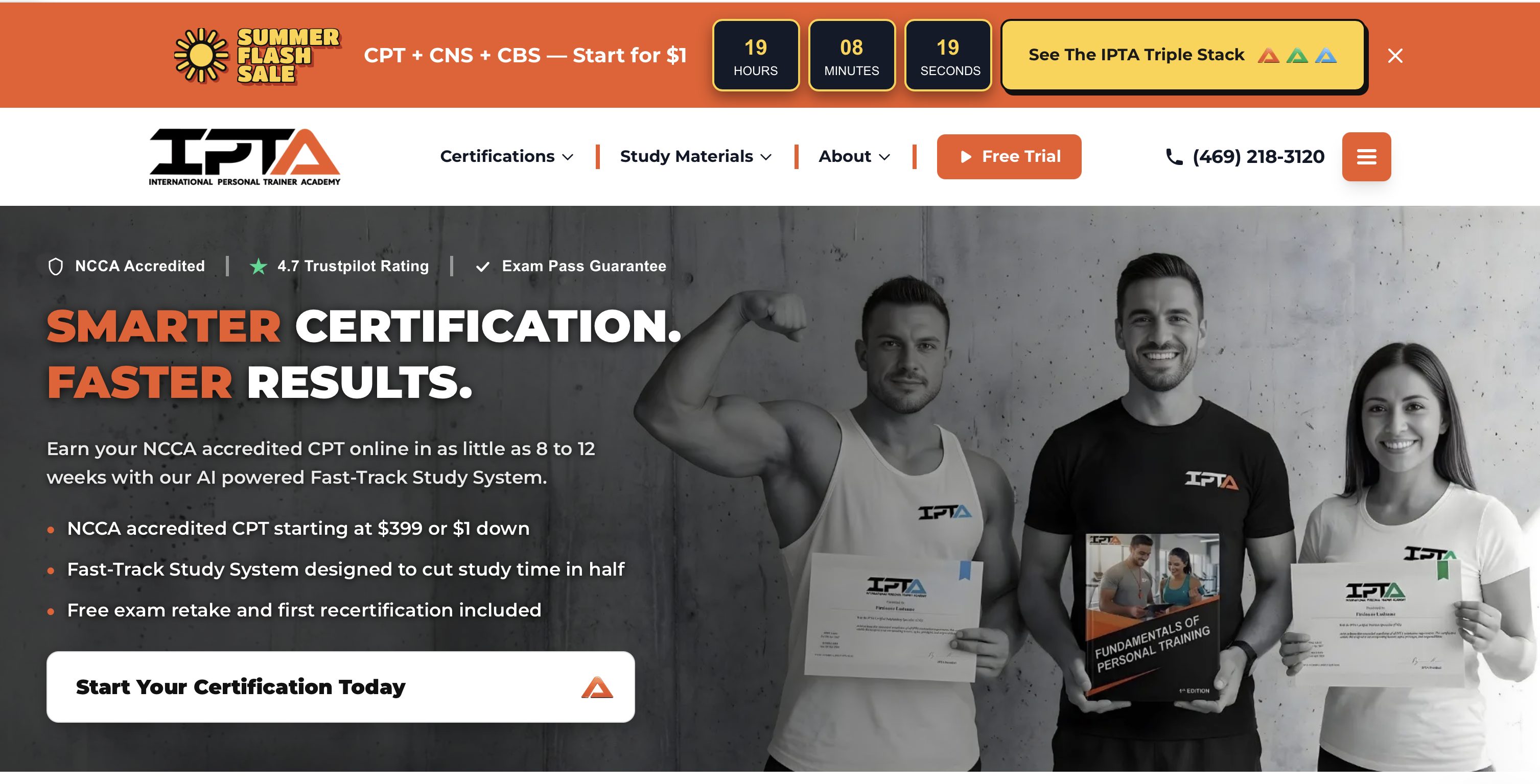
IPTA (International Personal Trainer Academy) is an NCCA-accredited personal trainer certification with a $399 exam-only tier, a $799 MVP tier that now includes a second certification free, unlimited exam retakes, a free first recertification, free CPR/AED, and a free AI-enhanced digital textbook available on trial signup.
What IPTA costs
$399 buys the exam. It is the lowest exam price among NCCA-accredited certifications, and it is the only one on this list that does not leave you shopping for a textbook afterwards, because IPTA gives the digital textbook away free to anyone who registers for a trial account. No card, no commitment. Most providers treat the same book as a $100 to $200 add-on, and NSCA treats it as a $435 one.
That textbook has also been rebuilt. The current digital version runs an AI layer over the material that handles reading and review, so a candidate can question the book directly, pull an explanation of a concept they did not follow, and get targeted revision on the sections they keep losing marks on. It replaces rereading a chapter from the top with something closer to being tutored through it.
The MVP tier at $799, a standing discount from $999, is where the rest of the value sits, and it changed recently. It now runs as buy one, get one free. Every MVP candidate takes a second certification at no extra cost, picking a specialty to sit alongside the CPT from five options: nutrition, bodybuilding, corrective exercise, strength and conditioning, or group exercise. Nutrition is the usual pick. Two certifications at $799 work out to roughly $400 each, which is less than any single credential on this list costs once its study materials are counted.
MVP also carries free CPR/AED certification, unlimited free exam retakes, a free first recertification, SurePass AI, performance reporting, and a job assurance guarantee. It now includes free lifetime access to IPTA’s personal training software as well, which handles client programming, tracking, and delivery. For a new trainer, that is a recurring monthly subscription removed from the business before it starts.
The International Personal Trainer Academy also offers twelve interest-free monthly payments with no credit check, which matters for candidates who cannot cover the full amount at enrollment. NSCA offers no payment plan at all.
Why it is also the fastest
Most candidates take three to nine months to complete a CPT, and beginners asking for the fastest certification that is still accredited hear the same range back from people who have done it. IPTA’s study platform is built to compress that: research-backed sequencing and AI-driven adaptive review cut study time by up to 50 percent, which puts a focused candidate into client work in weeks rather than months.
For a career changer, that gap is not a convenience. Every month earlier you certify is a month of trainer income you would otherwise have lost.
Where the savings actually come from
The entry price is the headline, but retakes and renewals are where the gap widens.
At MVP, retakes are free and unlimited, against $199 at ACE, $200 at NASM, and $435 at NSCA. The first recertification is free, against $70 to $129 elsewhere. CPR/AED is included rather than bought, an expense every working trainer carries regardless. The second certification is included rather than bought, and no provider here sells a comparable pairing anywhere near $799.
Add the software access and the two-year cost of ownership pulls further from the sticker price than any competitor here can match.
Where it falls short
Name recognition is the real one. NASM has been certifying trainers since 1987, ACE since 1985, and NSCA was the first organization the NCCA ever approved. IPTA is new next to all three, and a gym manager working through a stack of applications recognises the older names faster. NCCA accreditation puts them on the same footing on paper, and it is the standard most employers screen against, but plenty of job postings still name specific providers by hand. Check what your target gyms list before you enroll rather than after.
Everything rests on self-study. There is no live class and no cohort, so the AI-led review either fits how you work or it does not. It suits a disciplined candidate logging in most days. It does nothing for someone who needs a scheduled class, a room, and an instructor expecting them. A print textbook is available, but it costs extra rather than coming bundled.
The $399 tier is a bare exam tier. Free retakes, free CPR/AED, the free first recertification, the second certification, and the software access all sit at MVP. Read IPTA as a $799 program with a cheap entry point rather than a $399 program with optional extras, and compare it on that basis.
The specialty catalogue is smaller than NASM’s. IPTA offers five: nutrition, bodybuilding, corrective exercise, strength and conditioning, and group exercise. NASM sells a longer list a trainer can keep adding to across a decade, and anyone certain they are heading toward athletic performance work will find NSCA’s depth in that one area hard to replace.
Read the guarantees closely. Job assurance and pass guarantees carry conditions at every provider that offers them, and what they are worth depends entirely on those terms rather than on the headline.
What candidates report
IPTA holds a 4.7-star rating on Trustpilot, high for an education provider at this price. Reviews cluster around the study system, the retake coverage removing the financial risk of a failed attempt, and the job assurance guarantee, which comes up repeatedly among career changers who needed more than a passing score.
ACE: mid-priced with the strongest coaching content
What ACE costs
$499 for the exam on its own, with no study materials attached. $587 for the entry package with the current discount, against $1,136 at the top tier. The $88 gap between the exam and the full package makes the exam-only option difficult to justify.
Payment plans run 3, 12, or 18 installments but require a credit check. Retakes cost $199. Recertification is the most expensive here at $129 every two years against 20 CEUs. The package price also excludes the NCCA-accredited exam, which adds $99.
Why it is worth considering
ACE is a nonprofit and one of the most recognized names in the field, accepted across North America and parts of Europe. Its Integrated Fitness Training model leans harder on behavior change and exercise psychology than any competitor here, which suits trainers whose clients struggle with adherence rather than programming. The exercise video library is strong and the web platform is the easiest of any provider to navigate.
Where it falls short
Ongoing costs are the problem for a budget candidate. A $199 retake plus $129 every two years plus the $99 accredited-exam upgrade compounds faster than the entry price suggests.
Exercise science coverage is thinner than competitors’, and business and sales skills are barely addressed, which matters for anyone planning to work independently rather than on a gym floor.
NASM: most expensive of the mainstream options, most recognized
What NASM costs
$599 for the exam alone, with no preparation materials. $899 for the self-study package at full price, commonly discounted to around $749, rising to $1,597 at the top tier. As with ACE, the exam-only route saves so little against the discounted package that it only makes sense for candidates who already have the background.
Four interest-free payments are available with no credit check. Retakes cost $200 and recertification is $99 every two years against 20 CEUs.
Why it is worth considering
NASM is the most popular certification provider and one of the most recognized names in fitness credentials. The OPT model gives new trainers a structured program design framework rather than an open-ended one, which means fewer programming mistakes early in a career. Study resources are among the best available, with the largest exercise library and the strongest instructional video content of any provider.
Where it falls short
On a cheapest list, price is the obvious issue. Even discounted, NASM’s entry package costs nearly double IPTA’s exam-only price for the same NCCA accreditation, and its $599 exam-only price is 50 percent higher than IPTA’s.
The exam is demanding and the material is dense for a beginner without a fitness background, so candidates are advised to plan for at least a few months of study. The OPT model’s narrowness is also a long-term tradeoff, since it can be harder to adapt as a trainer becomes more advanced.
NSCA: cheap exam, expensive everything else
What NSCA costs
The exam runs $435 for non-members. Members pay less, but NSCA membership is a paid annual product, so $435 is the number a first-time candidate should plan around.
Nothing comes with it. The textbook and study program are bought separately and add roughly $435 again, which puts a realistically prepared candidate around $870. No payment plans are offered. Recertification requires 60 CEUs every three years at $70.
Why it is worth considering
NSCA was the first organization approved by the NCCA and is a global authority in strength and conditioning research. The textbook runs to roughly 700 pages of genuinely detailed material, and its coverage of program design, periodization, biomechanics, and athlete assessment is the deepest of any CPT here. For a trainer heading toward performance work, that depth pays off.
Where it falls short
The exam-only pricing is the trap. Study resources are bought separately, which roughly doubles the real cost, and the exam is offered in person only.
The $435 retake fee is the highest on this list by a wide margin, exceeding IPTA’s entire exam-only price. Business skills are not covered at all, and the volume of material means most candidates need several months of preparation. There is no payment plan, so the full amount is due up front.
How to choose when budget is the constraint
Compare exam-only prices first, then check what each one leaves out. $399 at IPTA, $435 at NSCA, $499 at ACE, and $599 at NASM look like a narrow spread until you notice that three of the four still need a textbook bought separately, and one of those three needs $435 of it.
Work out your realistic total before comparing enrollment prices. Add the package cost, the textbook if it is not included, CPR/AED certification if it is not bundled, one retake at the provider’s fee, and the first renewal with its CEU cost. That number is what you are actually choosing between, and it separates these four much further than their advertised prices do.
Treat accreditation as binary. NCCA status is what most gyms and insurers require. Anything without it belongs in a different conversation, however cheap. Confirm the accredited version of the exam is included rather than sold as an upgrade.
Count the certifications, not just the price. A CPT plus a specialty is what most trainers end up holding within two years anyway. IPTA’s MVP includes the second one; everywhere else it is a separate purchase at a separate price.
Check what a payment plan actually requires. IPTA and NASM offer interest-free installments with no credit check. ACE requires one. NSCA offers none. For a candidate with thin credit or no savings, that decides access regardless of price.
Weigh retake exposure honestly. If you are returning to study after years away, free retakes are worth more than a lower entry price. The gap between free and $435 is larger than the gap between the cheapest and most expensive exam here.
Count the time, not just the money. A program that takes six months instead of six weeks costs you roughly five months of trainer income. On a tight budget, that is usually the largest number in the entire calculation, and it never appears on a pricing page.
Match the credential to the work you want. NSCA’s depth is worth its cost if you are heading toward athletic performance. It is overkill and overpriced for a trainer working general population clients in a commercial gym.
Call two local facilities before committing. Acceptance varies by chain and by region more than candidates expect, and it is the one thing a comparison table cannot tell you. It is also the point career threads on which certification actually lands the job keep returning to.
Frequently asked questions
What is the cheapest CPT certification? IPTA at $399 is the lowest exam price among NCCA-accredited certifications. It is also the only exam-only price here that comes with a textbook, since IPTA’s digital textbook is free on trial signup. NSCA charges $435 for the exam for non-members, ACE $499, and NASM $599; none of them include study materials.
Is a cheap CPT certification worth it? It depends entirely on accreditation. An NCCA-accredited credential at $399 carries the same standing with employers as one at $899. A non-accredited credential at any price does not.
Is IPTA NCCA accredited? Yes. IPTA holds NCCA accreditation, the same accreditation held by NASM, ACE, and NSCA.
What is the difference between IPTA’s $399 and $799 tiers? $399 covers the exam, with the digital textbook free on trial signup. $799 MVP adds a second certification of your choice, unlimited free exam retakes, free CPR/AED certification, a free first recertification, SurePass AI, performance reporting, lifetime access to IPTA’s personal training software, and the job assurance guarantee.
Does IPTA offer specialty certifications? Yes. Nutrition, bodybuilding, corrective exercise, strength and conditioning, and group exercise. MVP candidates choose one of the five at no extra cost alongside the CPT.
How fast can I get certified? Most candidates take three to nine months to complete a CPT. IPTA’s study system is built to cut study time by up to 50 percent, which puts a focused candidate into certification in weeks. NASM, ACE, and NSCA all advise planning for several months.
What hidden costs should I expect? Textbooks, practice exams, CPR/AED certification, exam retakes, and recertification. Retakes range from free at IPTA’s MVP tier to $435 at NSCA. NSCA sells the exam without study materials, ACE and NASM do the same at their exam-only prices, and ACE charges $99 extra for the NCCA-accredited version of its exam.
Should I quote NSCA’s member or non-member price? Plan around the non-member price of $435. Membership lowers the exam fee but costs money itself, so the discount is not free and does not apply to a candidate who is only certifying once.
Do gyms accept cheaper certifications? Yes, provided they are NCCA-accredited. Employers screen for accreditation rather than price. Verify what your target gyms list before enrolling.
References
- PT Pioneer. https://www.ptpioneer.com/personal-training/certifications/cheapest-personal-trainer-certifications/
- Trainer Academy (IPTA). https://traineracademy.org/certifications/cheapest-personal-training-certifications/
- Exercise.com. https://www.exercise.com/grow/cheapest-personal-trainer-certifications/
- Insure Fitness. https://insurefitness.com/affordable-personal-trainer-certifications/
Further Reading…
- 4 Cheapest Personal Trainer Certifications in 2026
- 5 Best Personal Trainer Certifications in 2026
- Easiest Personal Trainer Certifications To Get in 2026
Published by
