Peptides vs SARMs: Muscle Growth, Safety and Side Effects

By the editorial research desk. Checked against primary literature and current FDA, USADA, and WADA guidance.
Peptides vs SARMs is a comparison people make when chasing muscle growth, fat loss, faster recovery, or a change in body composition. The two classes work through different biological pathways and are not interchangeable.
Selective androgen receptor modulators (SARMs) bind to androgen receptors, the same ones testosterone uses, and may produce direct effects on muscle and bone. They are marketed as milder alternatives to anabolic steroids, though they can still affect testosterone production, fertility, cholesterol, liver markers, mood, and cardiovascular health.
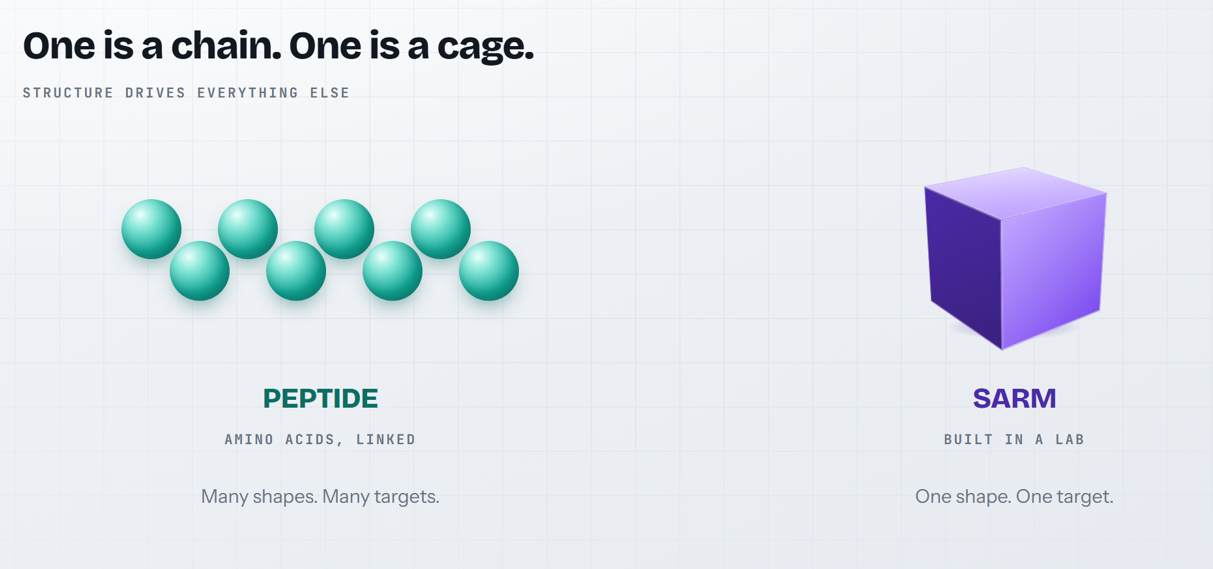
Peptides are a far broader category. Depending on the compound, a peptide may influence recovery, growth hormone signaling, appetite, metabolism, or tissue response. Most do not produce the direct anabolic effects SARMs do, and their safety profiles vary enormously from one to the next.
This guide covers what each class does, where the evidence stands, and how their regulatory positions differ.
Are SARMs and Peptides the Same Thing?
No. SARMs and peptides belong to separate chemical classes, and the differences start with chemistry and carry right through to the law.
- Structure: Peptides are short chains of amino acids, the same building blocks that form proteins. SARMs are small synthetic molecules made in a lab.
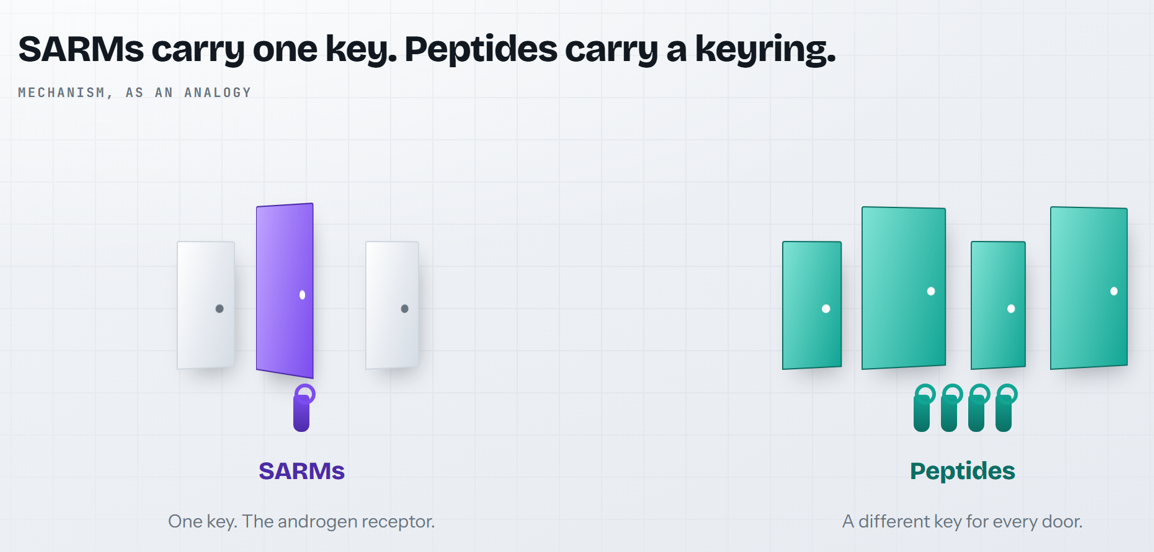
- Target: SARMs act on androgen receptors. Peptides use many different pathways, and the pathway depends on which peptide you pick.
- Breadth: The word “SARMs” names one class built around a shared target. The word “peptides” names a huge group whose members share only their basic shape.
Peptides vs SARMs: Quick Comparison Table
So which is better, SARMs vs peptides? The answer depends on the individual compound, and these seven points show where the two groups differ.
| Category | Peptides | SARMs |
|---|---|---|
| What they are | Short chains of amino acids | Synthetic small-molecule compounds |
| Mechanism | Varies by peptide | Androgen receptor activity |
| Common research areas | Hormonal signaling, tissue biology, metabolism, cellular pathways | Muscle, strength, and androgen-related research |
| Administration | Depends on compound | Commonly oral |
| Research status | Varies by compound | No approval for bodybuilding |
| Evidence | Varies a lot by peptide | Varies by individual SARM |
| Long-term data | Compound-specific | Limited for many SARMs |

What Are SARMs and How Do SARMs Work?
SARMs stand for Selective Androgen Receptor Modulators. These synthetic compounds activate androgen receptors in some tissues and stay dormant in others, which is why research focuses on muscle and bone. Every SARM is prohibited for athletes at every level, including recreational competitors.
How SARMs Work
Androgen receptors are present inside muscle and bone cells, where they normally respond to testosterone. A SARM binds that same receptor and sends a similar signal, which is why the effect is direct and the mechanism is well mapped.
The word “selective” describes what a compound aims to do, and it says nothing about safety. In practice, selectivity is partial, so compounds still act on tissues they were not designed for, and side effects follow.
Common SARMs You Will See Discussed
- Ostarine (MK-2866). It is the most studied in the class, and anti-doping labs detect it most often.
- Ligandrol (LGD-4033). Researchers have examined it in short trials measuring lean mass.
- RAD-140. Also called testolone, it arrived later and carries less data.
- Andarine (S-4). This older compound has been linked in reports to vision side effects.
What Are Peptides and How Do Peptides Work?
Peptides are short chains of amino acids, the same building blocks that form proteins. They act as signaling molecules, telling cells what to do, such as releasing a hormone or aiding repair. Each peptide binds specific receptors, so its effect depends on which pathway it targets in the body.
How Peptides Work
Each peptide has its own receptor or pathway. Some tell the pituitary to release growth hormone, while others affect blood vessel formation. Because each one works differently, reading one study and applying it to the whole group produces a claim the evidence never made.
Peptides Commonly Discussed in Fitness Research
- Growth hormone peptides: Ipamorelin, Sermorelin, and CJC-1295, all studied for how they affect the body’s own growth hormone release.
- Recovery and tissue research: BPC-157 and TB-500, which appear in tendon, muscle, and soft-tissue models.
- Other research areas: GHK-Cu appears in skin and copper work, while MOTS-c appears in metabolic work.
Evidence quality and legal status shift sharply from one name on that list to the next.
Peptides vs SARMs: How They Work Differently in the Body
Peptides vs SARMs comes down to one mechanical difference: SARMs converge on a single receptor family, while peptides spread across many unrelated pathways.
SARMs: One Receptor, One Signal
A SARM attaches to the androgen receptor, the same one testosterone uses, and signals muscle and bone to grow. Because every SARM works this way, research on one tends to align with research on the others, even when the results aren’t identical.
Peptides: Many Different Signals
A peptide works differently depending on which peptide it is. Growth hormone peptides like Sermorelin act on the pituitary gland, telling the body to make its own growth hormone. Repair-focused peptides like BPC-157 are studied for a completely different job, tied to how blood vessels form.
The Key Difference
SARMs are one group built around a single target, so they are easy to compare. Peptides are a broad group of unrelated compounds doing unrelated jobs, so lining them up against each other rarely tells you much.
SARMs vs Peptides for Different Fitness Goals
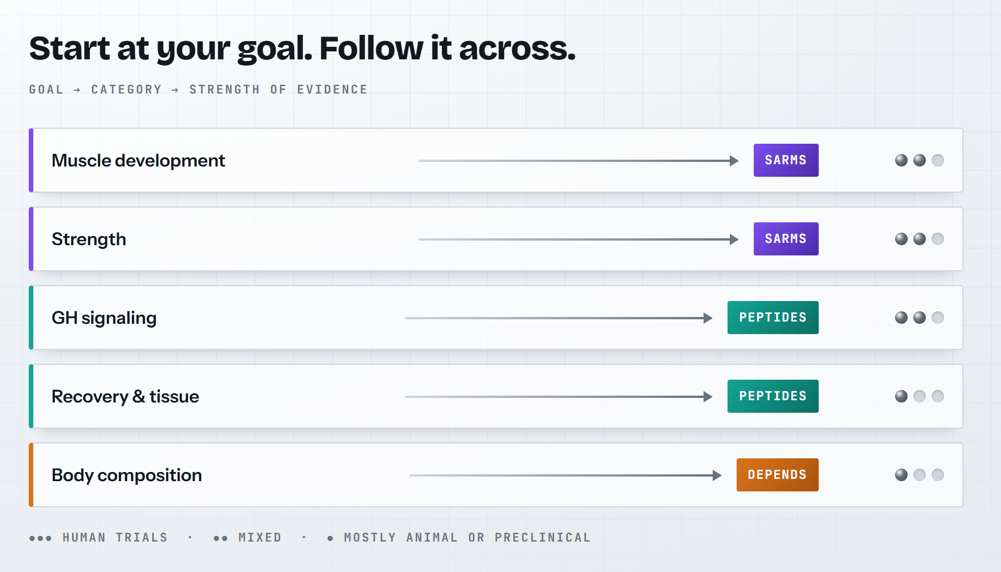
Choosing between SARMs and peptides for fitness depends on the goal, because the two are studied for very different things.
Muscle Development
SARMs act on the androgen receptor, which signals muscle growth. That direct link is why most muscle-building research uses them. Only a few peptides touch this area at all, and the ones that do work in a roundabout way.
Strength and Performance
SARM studies often measure strength along with muscle size, because both come from the same pathway. Peptide studies rarely measure strength at all. So when you see claims about peptides boosting strength, they usually come from gym talk, and not verified research.
Growth Hormone Signaling
Peptides have their best research identity here, with Ipamorelin, Sermorelin, and CJC-1295 all acting on the body’s own growth hormone release.
Recovery and Tissue Research
BPC-157 and TB-500 appear across tendon, ligament, and soft tissue models, mostly in animals. A recent review found only three human pilot studies on BPC-157 and called it investigational.
BPC-157 vs SARMs therefore compares two things measured against completely different endpoints.
Body Composition
People often ask whether SARMs or peptides are better for losing body fat. The honest answer is that neither group has strong, consistent fat-loss research behind them. This is one of those goals where the question matters more than either answer.
| Fitness Goal | Compounds Commonly Researched | Key Difference |
| Muscle development | SARMs: ostarine, ligandrol, RAD-140 | Act on the androgen receptor directly |
| Strength | SARMs: ostarine, ligandrol | Strength tracks lean mass on one pathway |
| GH signaling | Peptides: Ipamorelin, Sermorelin, CJC-1295 | Prompt the body’s own growth hormone |
| Recovery and tissue research | Peptides: BPC-157, TB-500 | Tissue-repair pathways, mostly animal data |
| Body composition | Both, depending on the compound | Evidence varies from compound to compound |
Results Timeline: How Long Do Peptides and SARMs Take?
There is no reliable human timeline for either group, because the controlled long-term studies that would establish one mostly do not exist. Most timelines you see online come from user reports and gym forums, not from research, so treat any exact “weeks to results” figure with caution.
- The specific compound. Half-life, receptor affinity, and route of administration all differ hugely within both groups.
- The study design. A cell-culture endpoint runs on a different scale from a whole-organism one.
- The endpoint measured. Tissue markers, hormone levels, and lean mass each move at their own speed.
- Individual variables. Age, starting point, and underlying biology shift results between subjects in the same trial.
Safety: Peptides vs SARMs Side Effects and Risks
Neither group is automatically safe. SARMs carry a fairly consistent set of systemic risks, while peptide risk varies from compound to compound.
SARMs: Key Concerns
- Hormonal effects, including suppression of the body’s own testosterone
- Changes in lipid markers
- Liver concerns with some compounds, and the FDA warning on SARMs cites liver injuries that sent people to the hospital.
- Thin long-term safety data across the class
- Quality problems and mislabeling in the online market
Peptides: Key Concerns
- Safety profiles that belong to each compound rather than the group
- Little human data behind many research peptides
- Purity and contamination risk from unverified suppliers
- Risks tied to how a compound is handled, where injection is involved
- Legal status that runs from approved medicine through to research-only
Which Is Safer?
Safety rests on the compound, the strength of its evidence, the quality of what is in the vial, and its regulatory standing.
A well-studied peptide with published safety data and an unverified one from an anonymous seller share a category and nothing else.
Are SARMs Legal? Peptides vs SARMs Regulatory Status
No SARM is approved for human use, and their easy availability online carries no regulatory weight. Peptides work differently, but neither matches the marketing around them, and the confusion usually starts in the gap between what gets sold and what gets approved.
SARMs and the FDA
No SARM has FDA clearance for bodybuilding or performance use. Ostarine is the most studied, and it is not approved for human use in the United States or anywhere else. In sport, SARMs belong to section S1.2 of the WADA Prohibited List as other anabolic agents.
Peptides and the FDA
Peptide status swings widely from one compound to the next. Some are approved medicines with full prescribing information, while others remain investigational or are sold only as research materials.
BPC-157 shows how specific this gets. The FDA placed it in Category 2 of its bulk drug substances review, the tier for substances that may carry real safety risks. Research-use-only labeling means a product is sold for lab work and is not cleared for people or animals.
How to Evaluate Research Peptides or SARMs Before You Buy
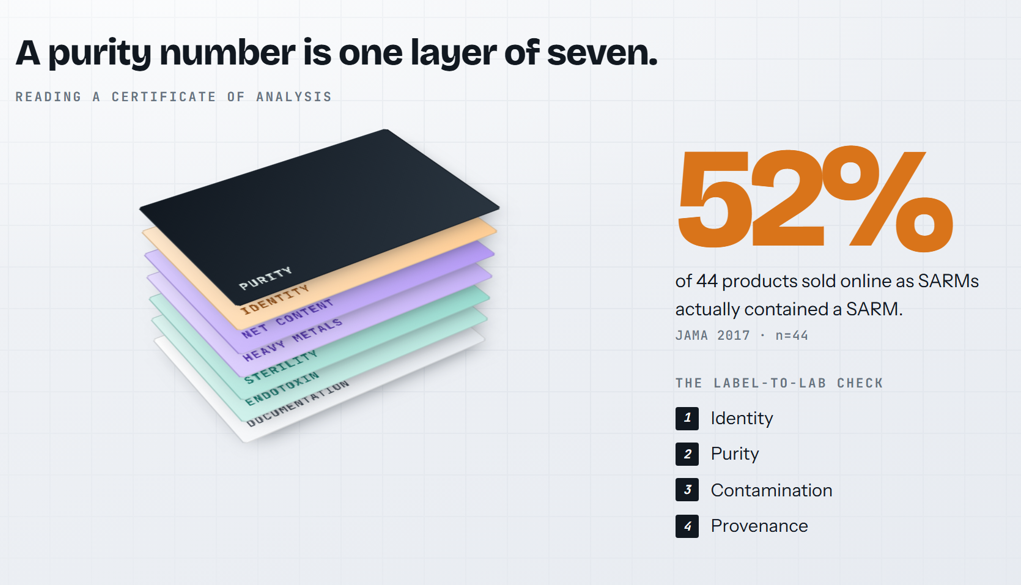
A research peptides certificate of analysis is where evaluation starts, because the vial label is the least reliable part. When researchers analyzed 44 products sold as SARMs, only 52 percent held a SARM at all.
Another 39 percent held a different unapproved drug, nine percent held no active compound, and only 41 percent matched the amount printed on the label.
Those numbers are why you should read a certificate properly. Use the Label-to-Lab Check, four questions a real certificate answers and a marketing page never does.
- Identity: Does the certificate confirm the compound by mass spectrometry? A purity number alone can’t tell you which molecule was purified.
- Purity: Does the certificate include an HPLC purity result with a stated threshold, tied to the lot you are receiving?
- Contamination: Does the panel cover heavy metals, sterility, and endotoxin, or does it stop at purity?
- Provenance: Did an independent accredited lab run the tests, and does the lot number match the vial?
Reliable suppliers such as Kylo Peptides run a seven-assay panel on every lot across three independent ISO/IEC 17025 laboratories, Janoshik, Freedom Diagnostics, and Vanguard, and post the lot-matched certificate before an order ships. Purity runs against a ?99% HPLC target with each lot’s measured figure printed rather than rounded, and the panel includes net content, which reports how many milligrams are actually in the vial.
FAQs
Are peptides safer than SARMs?
Not necessarily. Both are unapproved for human use, and safety depends on the specific compound, not the category. Some peptides are gentler; some carry real risks. Neither group is proven safe.
Are SARMs legal?
Selling a compound as a research chemical and getting it approved for people are two separate things. No SARM has FDA clearance for performance use, and every SARM is banned in sport at all levels.
Does the FDA approve peptides?
Some are, and many are not. Approval also attaches to a specific medical use rather than to the molecule itself. An approved peptide is not approved for every purpose someone might suggest.
Can you do SARMs and peptides together?
Combining unapproved compounds multiplies unknowns. Interaction data for these pairings are essentially absent from the literature, so no research supports any specific combination.
Can peptides and SARMs be compared directly?
Only on narrow ground. Comparing one named SARM to one named peptide on a shared endpoint is fair. Comparing the groups is not, and peptides vs SARMs vs steroids charts mislead for that reason.
Final Verdict:
A SARM works through one specific mechanism, acting on the androgen receptor. Peptides are not a single mechanism at all. They are a broad group of different compounds, each doing a different job.
That difference is why “which one is better” is usually the wrong question. The better question is which one has research behind the specific goal you care about, and for several goals, only one of them does, if either.
What actually matters is the strength of the evidence, where each stands with regulators, and the quality of the product itself, not which label it falls under.
Disclaimers
This article is educational only. It is not medical advice, diagnosis, or treatment, and nothing here should guide personal use of any compound. Many peptides and SARMs discussed here are sold for laboratory research use only and are not approved for human or veterinary use. Speak with a qualified healthcare professional before any health decision.
Published by
